







England is now facing a national disgrace created by consecutive British Governments.
Working families are falling into poverty at rates normally associated with far weaker economies. [Read Part 1 - Work Is No Longer Enough]
The latest IPPR and Action for Children research shows the situation clearly. Nearly 3 million children in working households are now living in poverty across Britain with England carrying the largest burden.
This is not happening because parents are refusing to work. The overwhelming majority are already employed.
The problem is the British Government’s economic model ‘being forced, without question’ onto England.
Compared internationally, Britain performs badly on in-work poverty. According to Eurostat data cited in the report, the UK has one of the largest poverty gaps in Europe between full-time and part-time workers.
That should alarm every Trade Union member.
Countries such as Denmark, Norway, and the Netherlands combine higher wages with stronger childcare systems, stronger collective bargaining, and better employment protections. Those nations understand something Britain forgot decades ago, wages alone do not determine living standards. Public infrastructure matters too.
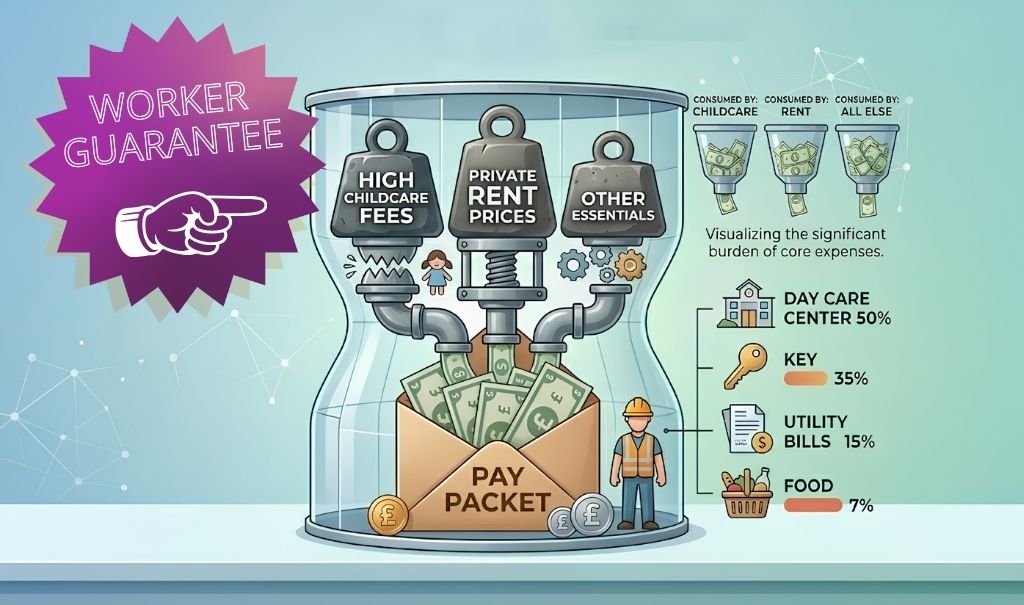
England’s childcare system is among the most expensive in Europe. Workers across England often pay huge proportions of their wages simply to remain employed. The IPPR research found that 20% of low-income parents said higher childcare costs made progression pointless.
In effect, workers are paying to go to work.
Housing intensifies the crisis further. Children in privately rented households face poverty risks of 41%, compared with only 12% for mortgage-owning families.
England’s county inequalities are equally stark. The research found that movement into and out of poverty varies dramatically depending on where workers live. In areas with higher numbers of single-parent households and larger families, in-work poverty rates climb sharply.
London presents a particularly brutal contradiction. Workers may earn more on paper, but soaring housing and childcare costs trap many families close to poverty even after wage increases. Meanwhile, in parts of the East of England, children are among the most vulnerable in Britain to falling into poverty after income shocks.
This is not merely an economic issue. It is becoming a national social emergency.
England increasingly resembles a low-security labour market economy, weak wage growth, expensive essentials, insecure contracts, declining social mobility, and overstretched public services.
The report highlights another major warning sign. Workers in routine occupations were almost twice as likely to move into poverty as those in non-routine jobs. Temporary workers and self-employed workers faced even higher risks.
That means huge sections of England’s workforce now live permanently close to financial collapse.
Workers of England General Secretary Stephen Morris said:
“England’s workers are carrying an impossible burden. Our members are working harder than ever while watching living standards collapse around them. A country as wealthy as ours should ours should never tolerate children living in poverty because wages are too low and work is too insecure.”
The uncomfortable truth is this. British governments have built an economy where profits and asset wealth surged while labour protections weakened.
Trade Unions understand what many politicians still refuse to admit. Poverty is not accidental. It is political.
Countries with stronger Trade Unions, stronger public services, and stronger labour protections consistently produce lower levels of child poverty.
England can do the same.
But only if workers across England organise strongly enough to force change. We urge our members to ask their family, friends and colleagues to join us as we want to protect your/ our future.
Stephen Morris
General Secretary
Workers of England Union
References
(Institute for Public Policy Research (IPPR), Work Isn’t Working: Family, Work and Progression on a Low Income, 2026, Eurostat, In-Work At-Risk-of-Poverty Rate Dataset, 2026, Office for National Statistics (ONS), Employment Rates by Parental Status, 2025, Department for Work and Pensions (DWP), Households Below Average Income Dataset, 2026 and different media outlets)
This Article is Tagged under:
Inflation, Poverty, Don’t Punish Workers, Campaign Group 6
Share Article


